10 Retail Merchandising Tips That Help FMCG Brands Increase Sales

Rod Smith
Managing Director, Engagement Group
October 27, 2025

Ten practical retail merchandising tips to help FMCG brands improve availability, shelf presentation, promotional compliance and in-store performance across New Zealand.
Engagement Group helps FMCG brands improve product availability, visibility and execution across New Zealand retailers. This guide covers ten practical retail merchandising tips and merchandising strategies for strengthening shelf presentation, promotional compliance, shopper engagement and in-store sales.
Strong products, recognised branding and successful retail listings do not automatically translate into strong store-level performance.
Once an FMCG product reaches the retail environment, it still needs to be available, correctly positioned, accurately priced and easy for shoppers to find. Promotional displays need to be installed and maintained, while planograms need to be executed consistently across participating stores.
Effective retail merchandising connects the strategy created by brand, sales and category teams with what shoppers actually encounter in-store. The following merchandising techniques can help FMCG brands protect their retail investment and improve performance across New Zealand.
1. Start with a clear merchandising objective
Turn the brand strategy into store-level action
Every merchandising programme should begin with a clearly defined commercial objective.
A new product launch may focus on distribution, visibility and trial. An established range may need support with stock availability, facings or planogram compliance. A promotion may require additional stock, accurate pricing and a retailer-approved secondary display.
Giving a field team a broad instruction such as “improve the display” leaves too much room for interpretation. A stronger brief explains the desired store condition and the action required to achieve it.
Decide how success will be measured
The measurement method should be agreed before activity begins. This helps the field team collect useful information and gives the brand a consistent basis for assessing results.
Tips:
- Define the priority SKUs, stores, retail channels and campaign dates.
- Document the required shelf position, facings, pricing and display standards.
- Set measurable KPIs that connect store execution with the commercial objective.
2. Keep planograms consistent across locations
Protect the agreed shelf presence
A planogram defines how products should be arranged within a category. It may specify shelf position, SKU order, facings and space allocation.
However, an approved planogram does not guarantee consistent implementation. Products may be placed in the wrong position, facings may be reduced, labels may not match the product, or a new SKU may not have been cut into the shelf correctly.
Regular store-level checks help brands identify the difference between the agreed layout and the reality on the shelf.
Use compliance reporting to identify problems
Planogram compliance should do more than produce a pass or fail result. Useful reporting explains what is wrong, whether it can be corrected and who needs to take the next action.
Photographic evidence also gives brand and category teams a clearer view of execution across stores and regions.
Tips:
- Provide clear and current planogram instructions to the field team.
- Check shelf position, facings, SKU order, tickets and missing products.
- Record corrected issues separately from problems requiring escalation.
For more information, see Planograms Explained: Why Product Placement Influences Buying Decisions.
3. Use shelf position to improve product visibility
Look beyond the eye-level rule
“Eye level is buy level” is a useful merchandising principle, but shelf height is only one factor influencing visibility.
Brands should also consider how shoppers approach the category, whether the product is easy to reach, how the packaging contrasts with neighbouring products and whether shelf edges or promotional material obscure important information.
The best position will vary according to the retailer, category, pack size and intended shopper.
Maintain enough visual presence
A strong shelf position can still underperform when the product has too few facings or insufficient stock.
Consistent facings create a more recognisable block of packaging and make the product easier to locate. They also give fast-moving products enough shelf capacity to remain available between replenishment visits.
Tips:
- Confirm that agreed shelf positions and facings are implemented in-store.
- Check visibility from the shopper’s natural direction of approach.
- Compare different placements using availability, compliance and sales data.

4. Refresh retail displays to maintain relevance
Keep promotional displays current
Retail displays can lose impact when graphics become outdated, stock sells through or the display no longer reflects the current campaign.
A refresh does not always require a completely new display. Updating the featured range, campaign message, promotional ticket or product arrangement may be enough to renew shopper interest.
For FMCG brands, the refresh schedule should follow promotional periods, seasonal demand, product availability and retailer requirements rather than an arbitrary calendar.
Design for real store conditions
A display must continue to communicate effectively after shoppers have removed products from it.
Important messages should remain visible when the display is partly depleted. The structure should also be durable enough for store traffic, product handling and replenishment throughout the campaign.
Tips:
- Align display updates with the retail calendar and promotional programme.
- Check that pricing, stock and campaign messages remain current.
- Design displays that continue to work as products sell through.
5. Use brand ambassadors to encourage trial
Add human engagement when the product needs explanation
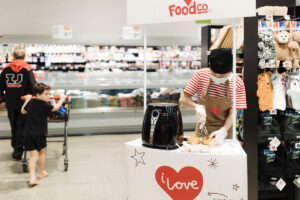
Some products can communicate their value through packaging alone. Others become more compelling once shoppers can taste, test or see them being used.
Brand ambassadors can support new launches, unfamiliar products and premium propositions by explaining key benefits and answering questions. This can reduce uncertainty and give shoppers more confidence to try the product.
Turn shopper conversations into useful feedback
A well-briefed ambassador can also give the brand direct insight into shopper reactions.
Questions, objections and reasons for declining a sample can reveal opportunities to improve campaign messaging, packaging or future activity. This makes the activation a source of learning as well as a sales opportunity.
Tips:
- Schedule activations during relevant, high-traffic shopping periods.
- Train ambassadors on product benefits, usage and common questions.
- Track interactions, samples, sales and qualitative shopper feedback.
Learn more about Engagement Group’s in-store brand ambassador services.
If you want to elevate your in-store execution and increase retail sales, our team of experts can help. Combining merchandising expertise with brand ambassador engagement ensures your campaigns deliver both visibility and measurable results.
Talk to our team today to discuss how we can transform your retail merchandising strategy and boost your market share.
6. Use signage that informs shoppers quickly
Communicate one main message
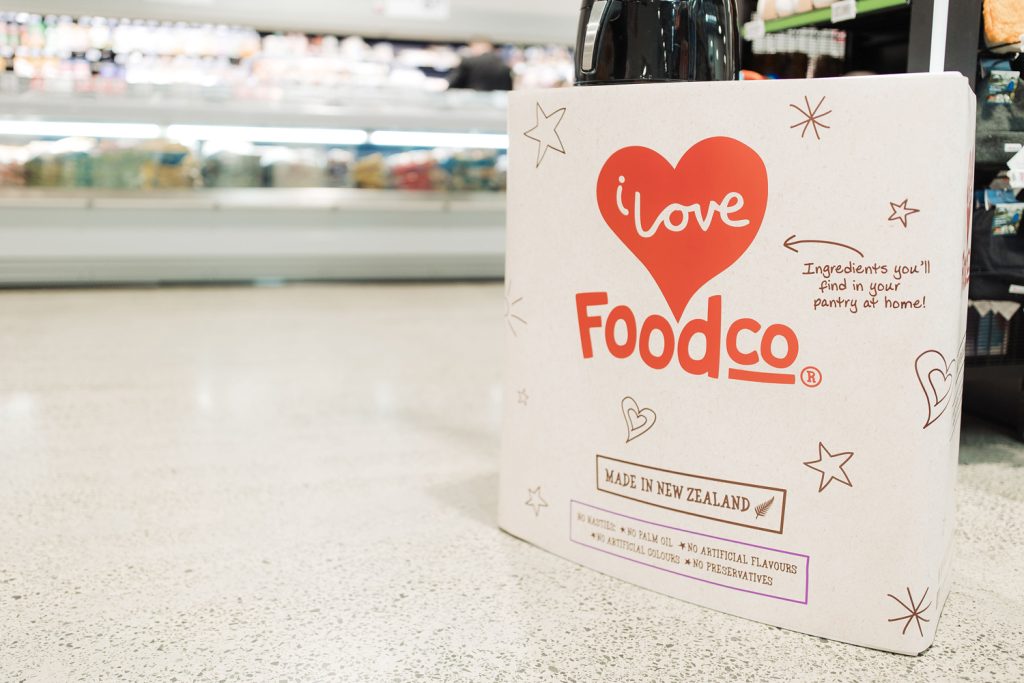
Effective signage helps shoppers understand a product, benefit or promotion without requiring a lengthy explanation.
The main message should be easy to read from the normal viewing distance. Pricing and promotional conditions should also be clear, accurate and positioned beside the correct product.
Trying to communicate too many claims at once can make signage harder to understand. In fast-moving retail categories, one relevant message will often be more effective than several competing points.
Maintain consistency with the product and campaign
Signage should support the packaging and broader campaign rather than introduce a different visual language.
Brand colours, product imagery and benefit claims should feel connected. This helps shoppers recognise the product and connect the in-store message with marketing they may have seen elsewhere.
Tips:
- Use concise copy and legible type.
- Make the product, benefit and price easy to identify.
- Check that signage remains visible and accurate throughout the campaign.
7. Build relevant cross-merchandising displays
Connect products through a clear usage occasion
Cross-merchandising places complementary products together to make an additional purchase feel relevant and convenient.
Examples include crackers near cheese, sauces beside meal ingredients, premium mixers near beverages and sunscreen beside seasonal outdoor products.
The strongest combinations reflect how shoppers actually use the products. The relationship should be understandable immediately, without requiring a detailed explanation.
Support the secondary location
A retailer-approved secondary location can increase product visibility outside the normal category, but it requires ongoing attention.
Stock levels, pricing and display condition should be checked regularly. Responsibility for maintaining the location should also be clear from the beginning of the campaign.
Tips:
- Choose product combinations based on a genuine shopper need or occasion.
- Confirm retailer approval before creating a secondary placement.
- Monitor stock, pricing and presentation in both primary and secondary locations.
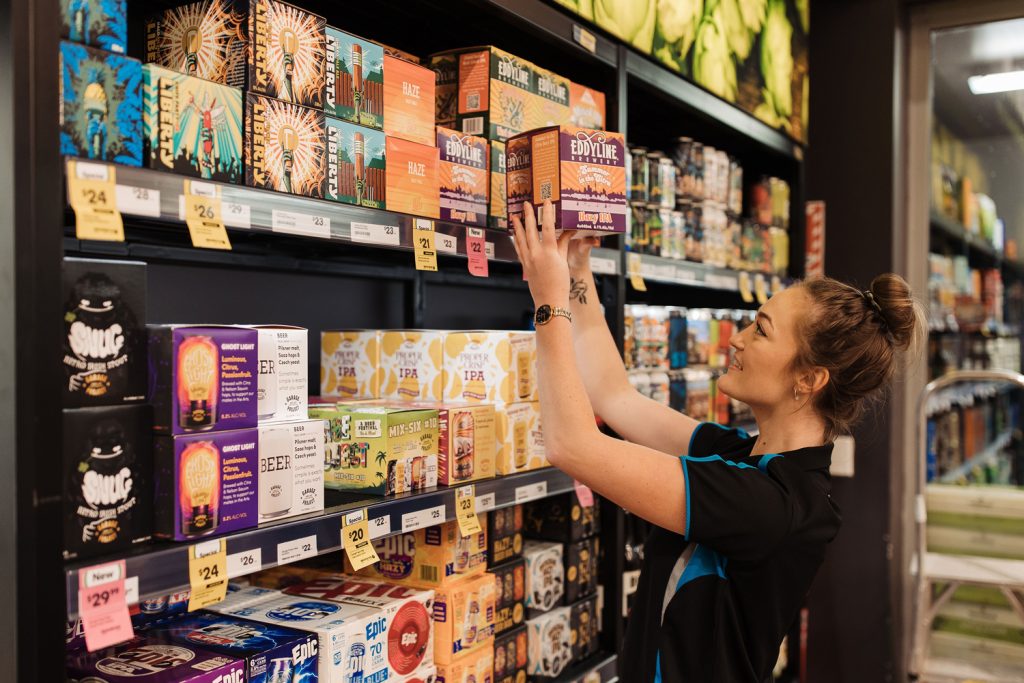
8. Maintain stock availability and shelf readiness
Make products physically available to shoppers
Availability is one of the most important elements of retail merchandising.
A product may be recorded as present in a store but still be unavailable on the shelf. Stock might be held in the storeroom, placed in the wrong location, mixed with another product or left in an empty promotional display.
Regular replenishment helps turn store inventory into shopper availability.
Match visit frequency to sales velocity
There is no single correct merchandising frequency for every product.
Fast-moving products, new launches and promotional lines may need more frequent attention. Established products with predictable demand may require a lighter schedule supported by regular compliance checks.
Tips:
- Base visit frequency on sales velocity, promotion timing and store conditions.
- Check both primary shelf positions and secondary displays.
- Record recurring availability issues so their underlying cause can be investigated.
9. Align merchandising with seasonal and promotional demand
Plan around New Zealand shopping occasions
Seasonal merchandising helps products remain relevant to what shoppers are doing at a particular time.
Christmas, Easter, Mother’s Day, back-to-school periods, summer entertaining and other occasions create different opportunities across food, beverage, household, health and personal-care categories.
Effective seasonal execution requires suitable products, sufficient stock and timely implementation. A strong creative concept cannot recover sales if the display appears late or runs empty during the busiest period.
Coordinate each part of the campaign
Seasonal campaigns often involve multiple teams, including sales, marketing, supply chain, retailers, merchandisers and brand ambassadors.
Clear responsibilities and timelines reduce the risk of stock, pricing, display and activation activity becoming disconnected.
Tips:
- Work backwards from the retail campaign dates.
- Confirm stock, tickets, POS material and field instructions before launch.
- Monitor execution early enough to correct problems during the selling period.
10. Measure and continuously improve performance
Connect sales outcomes with execution data
Sales results show what happened, but they do not always explain why.
A campaign may underperform because the offer was weak. It may also underperform because stock was unavailable, tickets were missing or displays were inconsistently implemented.
Combining sales data with store-level evidence helps brand teams distinguish between a strategy problem and an execution problem.
Measure the factors that can be acted upon
Useful merchandising measures include:
- On-shelf availability
- Stock weight
- Correct facings
- Planogram compliance
- Pricing accuracy
- Display presence and condition
- Promotional compliance
- Secondary-placement compliance
- Unit and value sales
- Rate of sale
- Sell-through
- Shopper interactions and feedback
Photographs and clear field commentary add context to the numbers. Reporting should also identify what was corrected during the visit and what still requires action.
Tips:
- Establish a baseline before the campaign begins.
- Review results by store, region, retailer or channel where possible.
- Use the findings to improve future briefs, visit schedules and campaigns.
Why consistent retail execution matters
The effectiveness of a merchandising strategy depends on what actually happens in stores.
Products move, displays become depleted, tickets disappear and store conditions change. A display that was compliant when installed may look very different several days later.
This is why retail merchandising should be treated as an ongoing commercial discipline rather than a one-time setup task.
Engagement Group provides retail merchandising services across New Zealand. Our field team supports stock replenishment, pricing checks, positioning, promotions, planograms, product launches and real-time reporting.
By acting as an extension of the brand team, we help turn retail plans into consistent store-level execution.
Frequently asked questions
What are the most effective retail merchandising techniques for FMCG brands?
Important techniques include maintaining on-shelf availability, checking planogram compliance, protecting agreed facings, confirming pricing and executing promotions consistently. The best combination depends on the product, category, retailer and commercial objective.
How does retail merchandising help increase sales?
Retail merchandising helps make products available, visible and easy to buy. It can also identify problems such as missing tickets, incorrect shelf positions, empty displays and stock sitting away from the shelf. Correcting these issues helps brands convert existing shopper demand into sales.
How often should a merchandiser visit a store?
Visit frequency should reflect product velocity, store traffic, campaign timing, stock levels and the risk of execution issues. Fast-moving or promoted products may need frequent visits, while stable products may require a lighter schedule.
What is planogram compliance?
Planogram compliance measures whether products are arranged according to the approved shelf layout. Checks may include shelf position, SKU order, facings, labels and space allocation. Reporting helps brands identify differences between the agreed plan and actual store conditions.
What should a retail merchandising audit include?
An audit may assess availability, stock weight, facings, shelf position, pricing, display condition, promotional compliance, product rotation and competitor activity. Photographs and clear field comments make the findings easier to verify and act upon.
How should merchandising performance be measured?
Brands should measure commercial results alongside execution. Sales, rate of sale and sell-through show what happened. Availability, pricing, facings and display compliance help explain why performance differed between stores or campaigns.
What is the difference between a merchandiser and a brand ambassador?
A merchandiser focuses primarily on product availability, shelf presentation, pricing, planograms, displays and reporting. A brand ambassador engages directly with shoppers through sampling, demonstrations and product education. Some campaigns benefit from using both.
Can Engagement Group support brands throughout New Zealand?
Yes. Engagement Group provides nationwide retail coverage for emerging and established brands with a New Zealand presence. Programmes can be tailored around particular retailers, regions, product ranges, campaigns and reporting requirements.
Turn your retail plans into consistent in-store execution
Effective retail merchandising is not simply about creating attractive displays. It is about ensuring products are available, correctly presented and supported throughout the campaign.
Engagement Group helps FMCG brands improve availability, shelf presentation, promotional compliance and shopper engagement across New Zealand. Our nationwide field coverage and real-time reporting give brand teams a clearer view of what is happening in-store and where action is required.
Contact Engagement Group to discuss an upcoming product launch, retail promotion or ongoing merchandising programme.
About the Author